| |
 
LEFT THE COLLECTION
display continued to support resarch | | | |
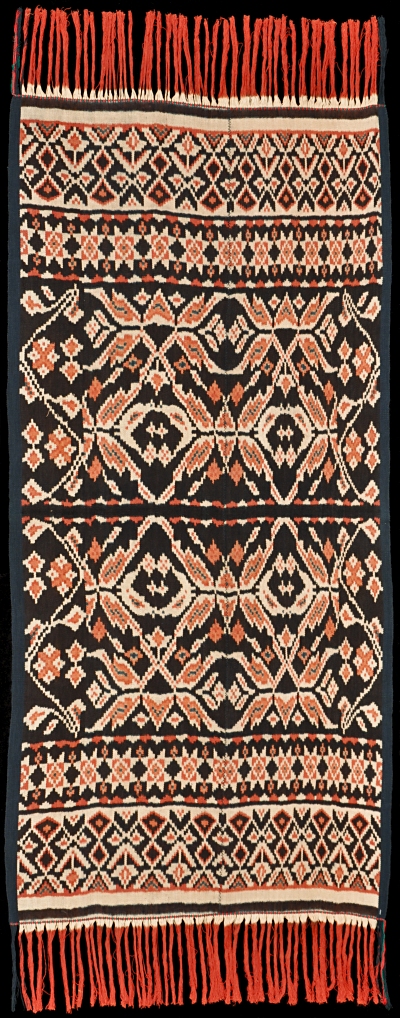
323 Roti Group, Roti
Lafa (shawl) 
| | Locale: | Nemberala, western Roti | | Period: | 1950-1960 | | Yarn: | Cotton, hand-spun, medium | | Technique: | Warp ikat | | Panels: | 2 | | Size: | 76 x 159 cm (2' 5" x 5' 2") LW: 2.09 | | Weight: | 403 g (14.2 oz), 333 g/m2 (1.09 oz/ft2) | | Design: | This weaving is strikingly asymmetric: design of both panels is essentially the same, but on the right-hand side everything has slimmed down by means of denser warp packing. As a result, the left panel is far wider than the right one, measuring 39 cm versus 30 cm, a difference of no less than 30 per cent. This effect was also observed, although in a less drastic form on Sumbahinggi and two men’s wraps from Timor. The method is described in Ikat Textiles of Eastern Indonesia: A Study of Style and Technique, Section 5.2 ‘Techniques to achieve asymmetry’, under ‘Pattern compression, Method 1’. The end borders are unusual as well, missing the common elongated triangles, tumpal, of patola inspiration. Executed in two shades of morinda red, two shades of indigo, yellow and green - created by brief overdyeing of yellow with indigo.� | | Comment: | It was this weaving that first alerted the author to the existence of pattern compression in Indonesian ikat textiles, and in that sense foundational for a core part of the author´s research. Obviously, any researcher who discovers the existence of such an unusual technique will look for it in any and all cloths encountered later. �The dyer’s motivation for creating this flagrantly asymmetric design - which runs counter to Rotinese tradition - is an enigma. Perhaps it was made for a husband from neighbouring Ndao or nearby Savu, where asymmetry is mandatory for all shawls. A perhaps more likely reason, given the present author’s identification of ikat as a competitive female activity (see Section 5.2), is that it represents sought complexity. The piece is in unused state, its fringes not yet corded. The yellow touches are indicative of high rank. Passed to collection Anja Philippart. | | Background: | Chapters on Roti Group and Roti. | | Published: | Ikat from Timor and its Outer Islands, 2022.
| | Compare: | 011 042 125 141 319 | | Sources: | No Roti cloth with similarly asymmetric pattern known from literature. Stylistically very similar to lafa from Nemberala (Nebrala) in Granucci, Art of the Lesser Sundas, Fig. 112, which also has yellow touches. | | |

©Peter ten Hoopen, 2026
All rights reserved.
|
|

 ONLINE MUSEUM OF INDONESIAN IKAT TEXTILES
CURATOR: Dr PETER TEN HOOPEN BROWSE FROM:
[RANDOM] [001] [050] [100] [150] [200] [250] [300] [350] [375]