| |
 
 | | | |
160 Sumba, East Sumba
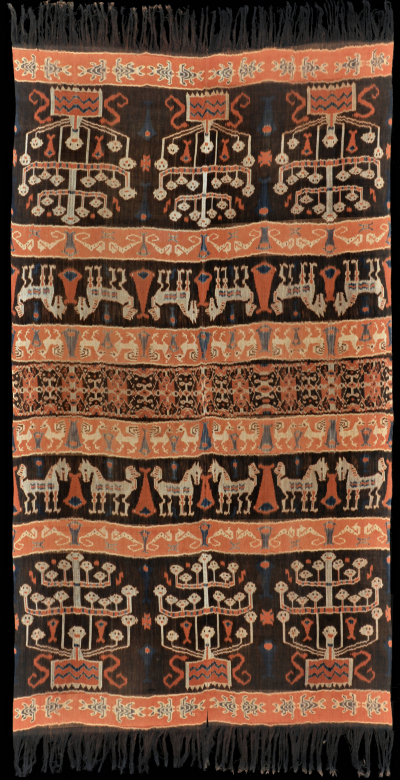
Hinggi (men's blanket)  
| | Locale: | Probably Kapunduk, may also be Rende. | | Period: | Circa 1925 | | Yarn: | Cotton, hand-spun, fine, double-ply | | Technique: | Warp ikat | | Panels: | 2 | | Size: | 132 x 240 cm (4' 3" x 7' 10") LW: 1.82 | | Weight: | 655 g (23.1 oz), 207 g/m2 (0.68 oz/ft2) | | Design: | Example of hondu lirang berbeda with both panels in hondu wallah (without longitudinal replication). The first impression is of a hondu kappit with 12 repeats in the endfields, but numerous differences between the three sections of the panels’ endfields preclude this, proving construction in labour-expensive in hondu wallah. Moreover, the various divergences between the left and right panels, reveal hondu lirang berbeda, with two entirely different panels (similar as they may seem to a casual observer). The detail photograph below highlights some of the many discrepancies across the cloth’s width that preclude replication. Unmarked is the girth of the red snakes: one on the left panel is circa 45 per cent wider than its counterpart on the right. These and several other measurements rule out that the variances result from a loss of warp and evince that the panels were created in hondu wallah and ikated individually. This could result from a mother-daughter team working in concert. If so, it must have resulted from joint planning and perhaps joint intent to deceive—to appear to replicate, but actually tie two ostensibly identical but slightly different panels (both probably with a twin), and reveal this in the details.� | | Comment: | An old hinggi with powerful design, rich, saturated tones, and fine weaving in double ply wheel spun cotton. Two tiny cuts, both less than one inch long, otherwise in excellent state of preservation, with strong colours. From old Dutch collection. Note the low specific weight, the result of very fine spinning. Creation at a high court is evident from the extremely fine hand-spun yarn, resulting in a specific weight less than half the norm, elevating it into a select group of early, intricate and exceptionally lightweight hinggi. Absence of kabakil border indicates that it was not meant to be used for attire, but for ceremonial use only. | | Background: | Chapters on Sumba and East Sumba. | | Exhibited: | Museu do Oriente, Lisbon, 2014/15 | | Published: |
Woven Languages, 2014.
Noble Virtuosity: Hidden Asymmetry in Ikat from Sumba, 2024. | | Compare: | 027 171 015 | | Sources: | Similar to hinggi from 1910 in Krefeld collection, depicted in Voelger & Von Welck, Indonesian Textiles, Fig. 152. Also similar to 19th C. hinggi with Kapunduk provenance, Van Ham Auction 366, Lot 2208: like treatment of the skulltree, rows of horses, but only seven ikated bands).� | | |

©Peter ten Hoopen, 2026
All rights reserved.
|
|

 ONLINE MUSEUM OF INDONESIAN IKAT TEXTILES
CURATOR: Dr PETER TEN HOOPEN BROWSE FROM:
[RANDOM] [001] [050] [100] [150] [200] [250] [300] [350] [375]