| |
 mouse over to magnify 
| | | | 002 Timor, East Timor
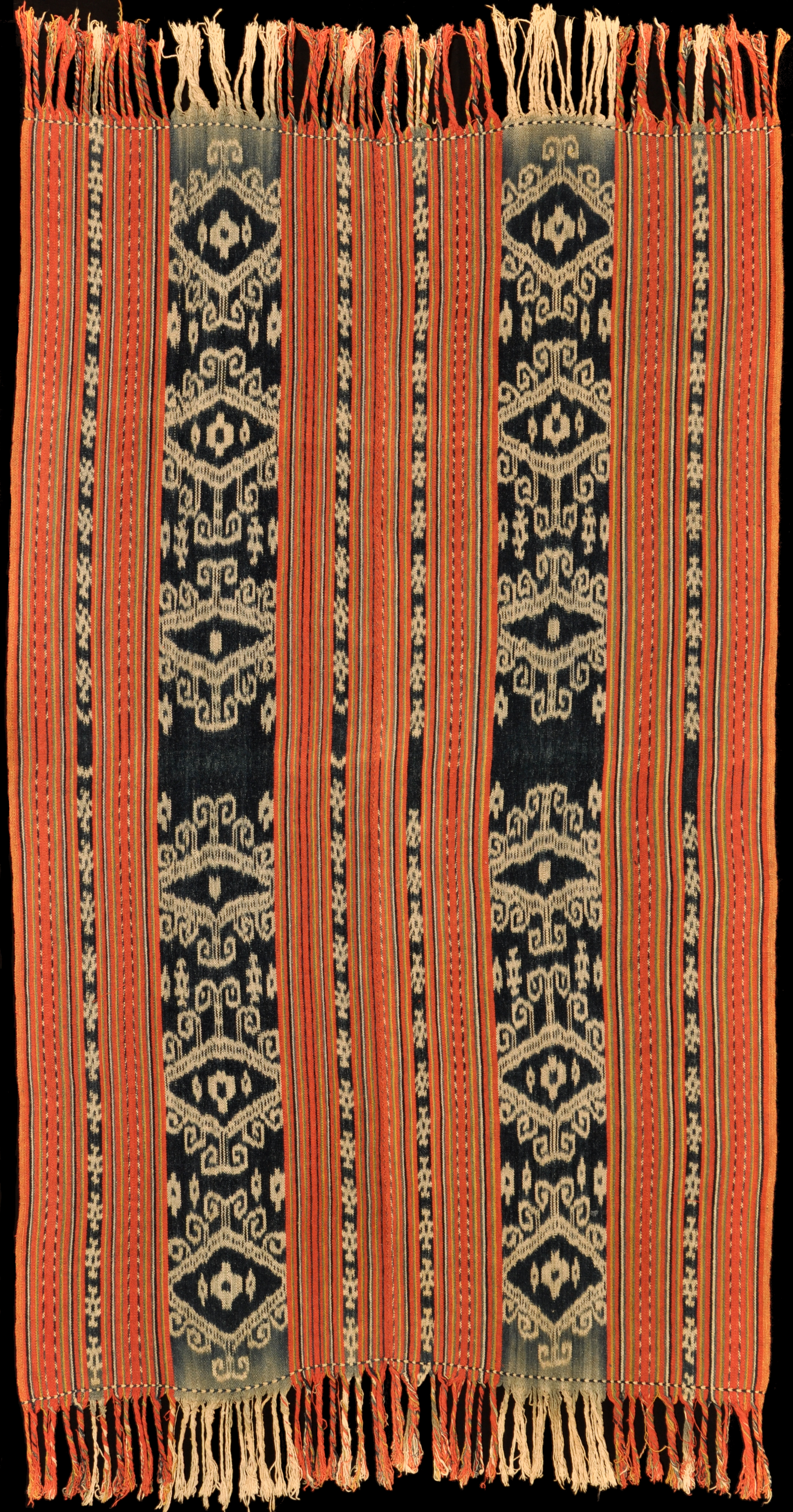
Beti naek (men's wrap)
| | Locale: | Oecusse/Ambenu, the East-Timorese exclave in West-Timor. Capital Pante Macassar or village in the lower elevations. Atoni people. | | Period: | Early 20th c. | | Panels: | 2 | | Design: | Asymmetry was achieved by a truly minor device: the insertion of four chevrons in the narrow ikated bands of the left panels—which do not have a counterpart in the right panel. This required placing four small ties on just one of the two layers of the circular warp, creating the reserves. A minuscule change that, however, did require intent, and targeted manipulation of the warp. Another asymmetric elements is found in the bands that border the widest ikated band: the two on the right panel are stippled, but on the left panel only the leftmost band is stippled, the other is not ikated.� | | Size: | 97 x 165 cm (38.1 x 64.9 in) | | Weight: | 855 g (534 g/m2) | | Yarn: | Hand-spun cotton, fine, double ply; twin warp, single weft | | Comment: | The cloth has the faint skatol smell (elegantly put the 'stable' smell') of ageing indigo. Cloths from Ambenu, especially early and vintage ones, are rare because of the area's isolation. | | Background: | Additional information in chapters on Timor and East Timor. | | Published: | Woven Languages, 2014.
Ikat Textiles of the Indonesian Archipelago, 2018.
Timor: Totems and Tokens, 2019.
Ikat from Timor and its Outer Islands, 2022.
| | Compare: | 256 169 118 189 | | Sources: | Nearly identical to beti naik from Taiboko village in Yeager and Jacobson, Textiles of Western Timor, Fig. 194, very to rather similar to Plates 192, 193. See also Chapter 8.4.2.2. Very similar to Ambenu beti in Fundação Oriente, Povos de Timor, Povo de Timor, p. 23 Fig, 2. Also very similar to our PC 169, 118 and 169, except that the latter two are both symmetrical. A very interesting cognate was discovered during a visit with curator Dr. Paulo Costa to the Indonesia section of the rich Francisco Capelo collection, held in Lisbon's new Casa Asia. Not just the motifs are similar, but also the minimal approach to creating asymmetry with tiny devices. In addition it has a much more marked form of asymmetry, that is still easy to overlook. Where in the specimen shown here there two narrow ikated bands running along the seam, in the Capelo specimen there is only one - and it runs entirely on the right panel. | | |
 ©Peter ten Hoopen, 2026
All rights reserved.
|
|

 ONLINE MUSEUM OF INDONESIAN IKAT TEXTILES
CURATOR: Dr PETER TEN HOOPEN BROWSE FROM:
[RANDOM] [001] [050] [100] [150] [200] [250] [300] [350] [375]